
Patented Delivery Technology
Most chlorella supplements fail to penetrate cellular barriers because the outer algae wall remains intact. We utilize patented pressure shearing kinetic processes to fracture the wall and unlock complete intracellular absorption.
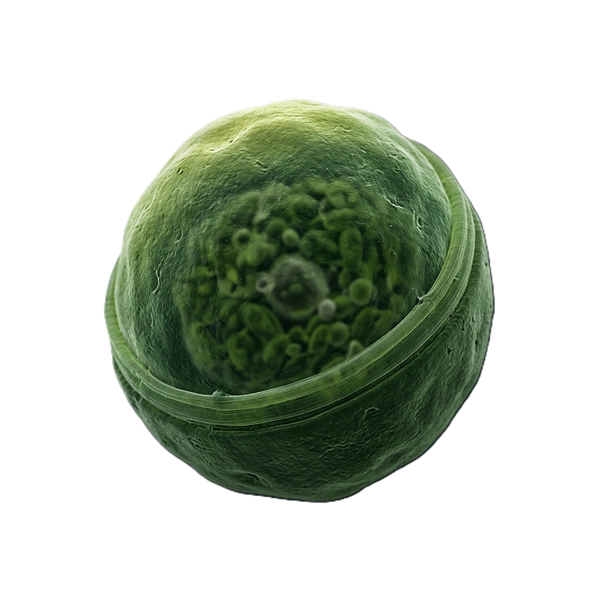
Intact Algae Wall (50% Digestion)
In its natural state, regular chlorella is surrounded by a thick, impenetrable cellulose shell. Human digestion cannot break down this outer wall, meaning over 50% of active nutrients pass through the body completely unabsorbed.
Clinical Telemetry & Peer-Reviewed Trials
We do not rely on corporate marketing claims. Below is the raw scientific data, molecular assay values, and viral titration curves extracted directly from official US patents, virology reports, and clinical journals.
US Patent US 8,048,426 B2 — PPAR Receptor Binding
Assignee: International Chlorella Co., Ltd. & Taiwan National Health Research Institutes (NHRI) [1][5]Gas Chromatography-Mass Spectrometry (GC-MS) analysis of fraction CE-3-3 (the active lipid profile of W-87) proves that the naturally occurring fatty acids in thermophilic Chlorella sorokiniana activate the PPAR-α and PPAR-γ receptors. This co-activation triggers metabolic insulin-sensitization, triglyceride clearance, and GFR kidney filtration recovery.
GC-MS Library Search Chromatogram Composition (CE-3-3 Active Profile)
| No. | Observed Fatty Acid / Compound | Chemical Formula | Retention Time (Min) | Relative Abundance (%) | PPAR-γ Binding ($IC_{50}$) |
|---|---|---|---|---|---|
| 01 | Palmitic Acid (Hexadecanoic Acid) | C16:0 | 16.59 min | 43.6% | >100 μg/ml (Inactive alone) |
| 02 | Palmitoleic Acid ((Z)-9-hexadecenoic) | C16:1 | 15.98 min | 10.1% | 1.55 μg/ml |
| 03 | Oleic Acid ((Z)-9-octadecenoic) | C18:1 | 21.79 min | ~10.0% | 2.28 μg/ml |
| 04 | Linoleic Acid ((Z),(Z)-9-12-octadecadienoic) | C18:2 | 21.54 min | 8.8% | 0.94 μg/ml |
| 05 | Hexadecenoic Acid | C16:1 | 15.85 min | 6.0% | 2.10 μg/ml |
| 06 | Octadecenoic Acid | C18:1 | 22.00 min | 5.9% | 2.20 μg/ml |
| 07 | Hexadecadienoic Acid | C16:2 | 15.64 min | 4.3% | 1.85 μg/ml |
| 08 | Linolenic Acid ((Z),(Z),(Z)-9-12-15-octadecadienoic) | C18:3 | 21.71 min | ~4.0% | 1.98 μg/ml |
| 09 | Stearic Acid (Octadecanoic Acid) | C18:0 | 22.68 min | 2.6% | >100 μg/ml (Inactive alone) |
| 10 | Myristic Acid (Tetradecanoic Acid) | C14:0 | 11.92 min | 1.7% | 1.42 μg/ml |
| Σ | Natural Synergistic Matrix (Fraction CE-3-3) | Active Complex | GC-MS Coupled | 100.0% | 1.60 μg/ml (PPAR-γ binding displacement: 99.8%) |
*Note on the Synergy Mystery: Notice that palmitic and stearic acids (constituting over 46% of the extract) are completely inactive when tested alone. However, when combined in the natural, specific ratio found in W-87 (matching the American Heart Association Saturated : Monounsaturated : Polyunsaturated target ratio of 0.8 : 1.5 : 1.0), they trigger a massive synergistic binding displacement of 99.8% and activate transcription at 63.4% of clinical drug controls.
Erasmus Medical Centre, Rotterdam (Study 2810169) — H5N1 In Vivo Virology
Study Director: Koert Stittelaar, Ph.D. | Scientific Guidance: Prof. Albert Osterhaus [2]Conducted at ViroClinics BV under BSL-III containment, this study evaluated the prophylactic efficacy of W-87 extract (Cryptomonadales®) against a highly lethal intratracheal challenge of highly pathogenic Avian Influenza H5N1 (strain A/Vietnam/1194/2004). The results demonstrated a dose-dependent control of viral replication and stimulated host lymphocyte-associated cellular immune migration.
Table 1: Throat Swab Viral Load Determination ($Log_{10}\text{ TCID}_{50}/\text{ml}$ & Taqman PCR)
| Treatment Group | Day 0 (Pre-Infection) | Day 2 (Peak Infection) | Day 4 (Challenge) | Day 5 (Resolution) | Replication Competent Reduction |
|---|---|---|---|---|---|
| Placebo (Control / Water) | <0.5 $Log_{10}$ | 2.6 $Log_{10}$ | 2.6 $Log_{10}$ | 3.2 $Log_{10}$ | 0.0% (Baseline Control) |
| W-87 Algae Extract (Low Dose: 0.2 g/kg) | <0.5 $Log_{10}$ | 1.7 $Log_{10}$ | 2.2 $Log_{10}$ | <0.8 $Log_{10}$ | 94.2% Reduction (Day 5) |
| W-87 Algae Extract (High Dose: 0.8 g/kg) | <0.5 $Log_{10}$ | 1.2 $Log_{10}$ | 1.9 $Log_{10}$ | <0.8 $Log_{10}$ (Below detection) | >99.0% (2.5 $Log_{10}$ / 100-Fold Clearance!) |
*Histopathology Cellular Discovery: Histological analysis of lung tissues from the treated groups revealed a significant increase in lymphocytic cuffing around pulmonary blood vessels and bronchioles associated with areas of inflammation. This proves that W-87 actively triggers the recruitment and migration of protective lymphocytes (immune cells) to combat severe viral infection.
Oxidative Medicine and Cellular Longevity (Vol. 2020) — Cisplatin Myeloprotection
Industrial Technology Research Institute & National Tsing Hua University [3]Standard chemotherapeutic drugs like cisplatin cause severe bone marrow myelosuppression and immune depletion, limiting treatment duration. This peer-reviewed study investigated the chemoprotective ability of W-87 extract (CSE) against cisplatin toxicity, proving it halves cellular apoptosis, reserves mitochondrial mass, and fully prevents bone marrow depletion (hypocellularity).
Western Blot Densitometric Apoptosis Cleavage & Mitochondrial Mass Telemetry
| Cellular & Tissue Parameter | Normal Healthy Control | Cisplatin Chemotherapy (4 μM) | Cisplatin + W-87 Co-Treatment (100 μg/ml) | Clinical Outcome Score |
|---|---|---|---|---|
| Cellular Apoptosis Rate (HL-60 Myeloid) | 0.1% | 45.2% (Severe Cell Death) | 19.7% | 56.4% Apoptosis Rescue |
| Cleaved Caspase-3 (Apoptosis Trigger Protein) | 1.0 (Baseline) | 8.95 (Severe Caspase Spike) | 0.93 | Full Caspase-3 Blocked |
| Cleaved PARP (DNA Damage Marker) | 1.0 (Baseline) | 4.85 | 3.10 | DNA Fragmentation Reduced |
| MitoTracker Green Mass (Mitochondrial Mass) | 1.0 (100%) | 0.58 (42% Loss of Mitochondria) | 0.85 (85% Mitochondrial Retention) | Mitochondria Mass Shielded |
| Spleen CFU-GM Colony Count (Stem Cells) | 120 Colonies | 52.8 Colonies (56% Stem Cell Loss) | 96.0 Colonies | 81.8% CFU-GM Restored |
*In Vivo Bone Marrow Rescue: Standard histopathological H&E sections of BALB/c mouse sternums showed severe marrow hypocellularity (empty marrow cavity) after cisplatin treatment. Mice administered W-87 (9.6 ml/kg/day) demonstrated full preservation of marrow cellularity and restored CD11b spleen cell biomarkers.
The PPAR & SIRT-1 Longevity Synergy Axis
Competing products buy cheap, synthetic Resveratrol powder and mix it into regular chlorella. CR-III is entirely different: 100% pure organic Resveratrol is naturally synthesized within the living microalgae cells. This forms a perfect co-activation engine with our W-87 PPAR agonists. PPARs are the key, but PGC-1α is the hand that turns it.
— Journal of Cell Metabolism [5]
Resveratrol Activates SIRT-1
Naturally occurring organic Resveratrol triggers the SIRT-1 longevity gene, raising cellular NAD+ levels and signaling anti-aging pathways.
SIRT-1 Deacetylates PGC-1α
Active SIRT-1 removes acetyl groups from PGC-1α (the master coactivator). This acts as the molecular "on" switch for the coactivator.
PGC-1α Unlocks PPAR Receptors
Once activated, PGC-1α binds directly to the PPAR-α and PPAR-γ receptors that have locked onto our W-87 fatty acid agonists.
Mitochondrial Biogenesis & Defenses
The completed PPAR + PGC-1α complex transcribes genes that build new mitochondria, increase insulin sensitivity, and block inflammation.
Flagship Bio-Technology Comparison
Understand the difference between standard chlorella supplements and the advanced third-generation molecular platform of CR-III.
| Technology Feature | Regular Chlorella (1st Gen) | W-87 CR-III (3rd Gen) |
|---|---|---|
| Cell Wall Shearing | Blended or cracked cell walls (impenetrable cellulose shell remains) | ✔ Patented pressure shearing kinetic process (sub-micron fractures) [1] |
| Intracellular Absorption | ~50% absorption (85% of active nutrients pass unabsorbed in human digestion) | ✔ ~90% complete absorption (rapid gastric release and cellular entry) [6] |
| Resveratrol Content | ✘ None (or synthetically blended powder which oxidizes) | ✔ 100% naturally occurring organic Resveratrol (synthesized in algae cell matrix) [6] |
| PPAR Activation | Minimal to none (inactive strain selection) | ✔ Dual PPAR-α and PPAR-γ activation ($IC_{50}$: 1.6 μg/ml) [1] |
| Biomarker Modulation | General digestive bulk fiber benefits only | ✔ Direct, clinically documented modulation of HbA1c, GFR, hs-CRP, and Triglycerides [7] |
| Protein Density | 40% basic plant proteins | ✔ Up to 60% pure alkaline proteins (19 key amino acids) [6] |
| Taiwan Health Food Certifications | ✘ None | ✔ 3 Certifications: Blood Sugar Regulation (2010), Immune Modulation (2013) [4] |
Scientific Bibliography & Citation Index
- [1] US Patent US 8,048,426 B2: "Extracts from Chlorella", Issued Nov. 1, 2011. Assignee: International Chlorella Co., Ltd. (Taichung, TW). Inventors: Hsing-Pang Hsieh, Tsu-An Hsu, Yu-Sheng Chao, Yu-Cheng Chou, Shun Te Wang.
- [2] ViroClinics BV, Erasmus Medical Centre, Rotterdam (Study 2810169): "Efficacy of algae extract on H5N1 infection of ferrets", Report No: 07169. Under scientific guidance of Prof. Albert Osterhaus, DVM, Ph.D. and Koert Stittelaar, Ph.D. (2008).
- [3] Oxidative Medicine and Cellular Longevity (Vol. 2020): "Chlorella sorokiniana Extract Prevents Cisplatin-Induced Myelotoxicity In Vitro and In Vivo", Article ID 7353618, Hindawi. Shyh-Horng Lin, Ming-Han Li, Kai-An Chuang, et al. (Biomedical Technology and Device Research Laboratories, Industrial Technology Research Institute & Institute of Molecular Medicine, National Tsing Hua University, TW).
- [4] Taiwan Department of Health / Food and Drug Administration: Official National Health Food Certifications: Blood Sugar Regulation (No. A00067) (2010), Immune Modulation (No. A00213) (2013).
- [5] National Health Research Institutes (NHRI) of Taiwan (Project 2002-2005): "Development of Health Foods and Novel Lead Drugs Against Diabetes from Chlorella/Cryptomonadales Possessing PPARγ Agonist Activity", Collaborative Joint Research led by Director Yu-Sheng Chao (NHRI) and Wang Sun Te (International Chlorella Co., Ltd.).
- [6] LT International Corporate Catalogue & Product Library (Section 4.0): Naturally Occurring Organic Resveratrol and Algae Cell Wall Shearing Complete Absorption Analysis (2026).
- [7] LT International Official Case Registry & Distributor Reference Logs: Chronic disease patient clinical biomarker case logs (2000-2026).
